
Cloud & Backend
SmartATS: AI-Assisted Applicant Tracking
A team-of-four ATS with LLM CV parsing and semantic ranking behind hard filters. I built CV upload and file processing, the UI and the analytics dashboards.
At a glance
- REST APIs
- 54
- across 10 modules
- multilingual embeddings
- 768-d
- pgvector HNSW, ranked only after boolean hard filters
- signed URL lifetime
- 15 min
- short-lived SAS links for CV files on Azure Blob
- panel approval to advance
- 80%
- consensus rule computed server-side
Problem#
Recruiters need to filter hundreds of CVs without a ranking model quietly overriding hard requirements. And an ATS holds exactly the kind of personal data attackers go after.
My role#
A team of four. I built CV upload and file processing, and the interface and analytics dashboards recruiters use to review candidates.
What it does#
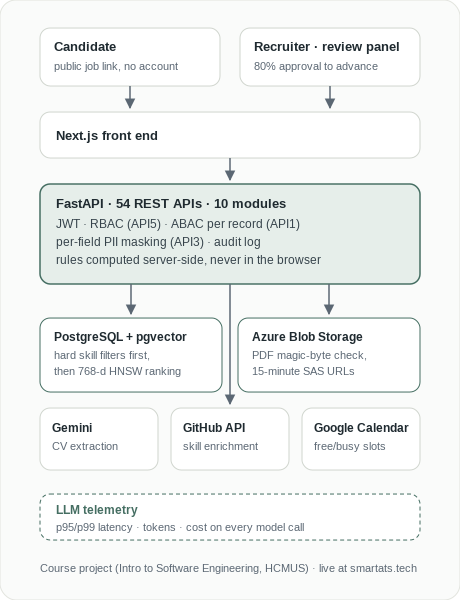
- Apply: a candidate uploads a PDF CV through a public job link; an LLM extracts structured fields.
- Rank: required skills run first as a hard filter; only those candidates are ranked by
multilingual-e5-baseembeddings with pgvector. - Enrich: public GitHub activity is summarised into a skills matrix.
- Review: a candidate moves forward only when 80% of the review panel approves.
The hard part#
Getting the extended analysis of candidates’ CVs to produce what we wanted. As a team, it took us many iterations and far more effort than we planned.
Decisions in my part#
- Treat uploads as hostile. Files are checked by their PDF magic bytes, not their extension, and served through 15-minute signed URLs from Azure Blob Storage instead of public links.
Team decisions#
- Hard filters before semantic search, so a missing required skill can’t be outranked by a good similarity score.
- Access control mapped to the OWASP API Top 10 (2023): per-record checks against ID enumeration (API1), per-field PII masking (API3) and role checks on admin functions (API5).
- Rules computed on the server. Thresholds and approval counts are sent to the browser, never re-derived there.
Limitations: what this does not prove#
SmartATS is a course project. It hasn’t handled production traffic, and ranking quality hasn’t been measured against real hiring outcomes.