
Applied AI
Insurance Fraud Detection: A Leakage-Safe ML Pipeline
145 behavioural features and a leakage-safe SMOTE + XGBoost pipeline that raised fraud recall from 18.4% to 65.0% at 0.840 ROC-AUC.
At a glance
- fraud recall
- 18.4% → 65.0%
- held-out data, before vs after the leakage-safe resampling pipeline
- ROC-AUC
- 0.840
- held-out data
- F1 (fraud class)
- 0.63
- at the chosen decision threshold
- engineered features
- 145
- behavioural and claim-level
Problem#
Fraudulent claims are a small minority. A model can be very “accurate” by predicting “not fraud” every time, and catch almost nothing.
A decision I made#
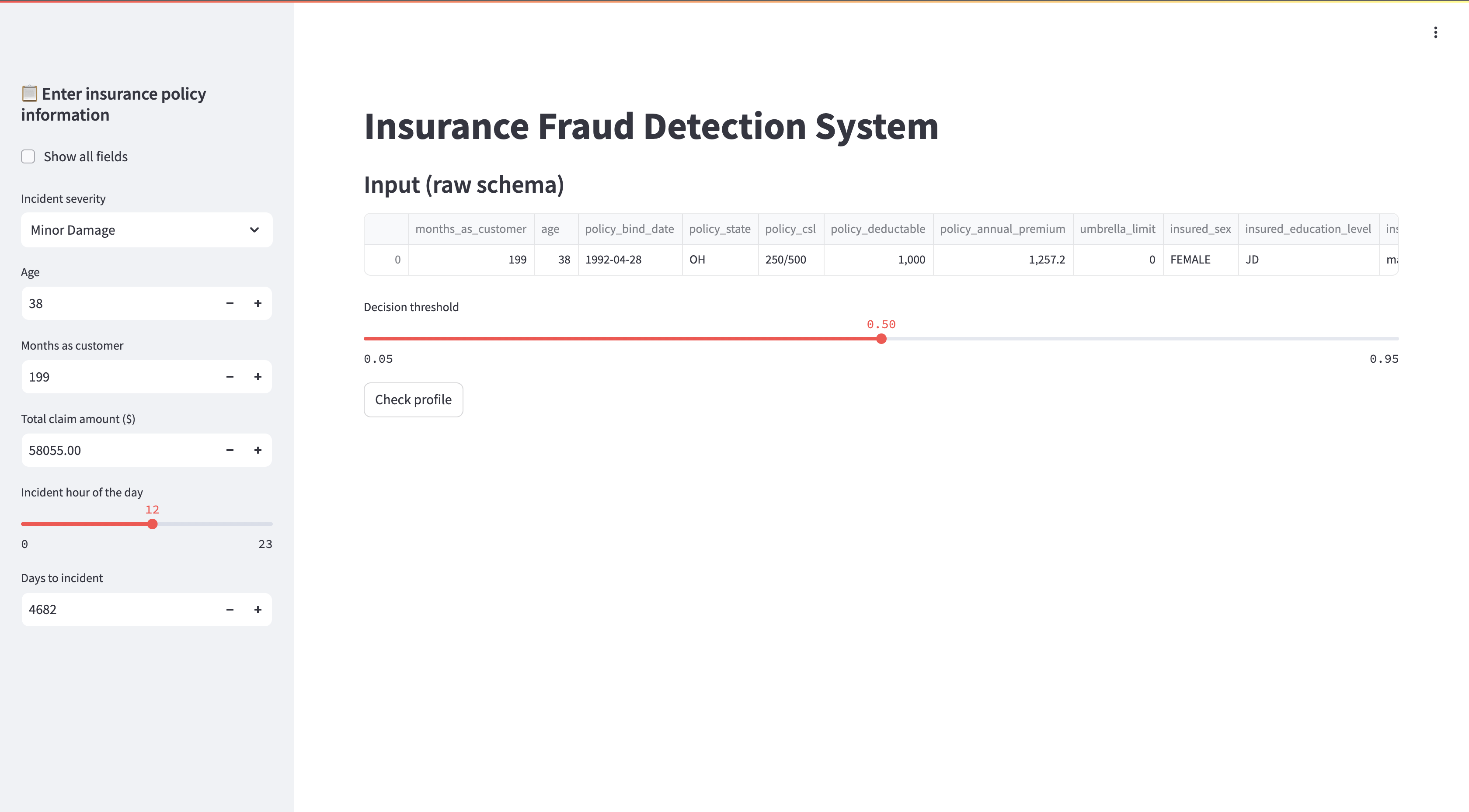
Prioritise recall. In fraud, being right 99 times and missing once can still cost a lot, so I’d rather flag too many claims than miss real ones. But if everything gets flagged, investigators drown in reviews. So the decision threshold has to balance the two, and I exposed it so it can be tuned against review costs.
How I kept the evaluation honest#
- Split the data by time, so the test set holds later claims than the training set.
- Applied SMOTE and scaling only inside the training folds of stratified K-fold, so nothing from validation data leaks into training.
- Kept everything in one scikit-learn pipeline, so training and serving apply identical transformations.
What I built#
- 145 behavioural features and an XGBoost classifier, with SHAP explanations for individual predictions.
- Served through FastAPI and a Streamlit dashboard with Docker Compose, covered by automated tests and schema contracts.
Results#
Recall on the fraud class rose from 18.4% to 65.0% at 0.840 ROC-AUC, with an F1 of 0.63.
Limitations: what this does not prove#
- 65% recall still means roughly one in three fraud cases is missed.
- The model was trained and tested on a public dataset, not an insurer’s production data.
- The best threshold depends on cost assumptions that would need to come from the business.